
Orthodontic Clinic or High Street Dentist: How to Decide Where to Have Your Teeth Straightened
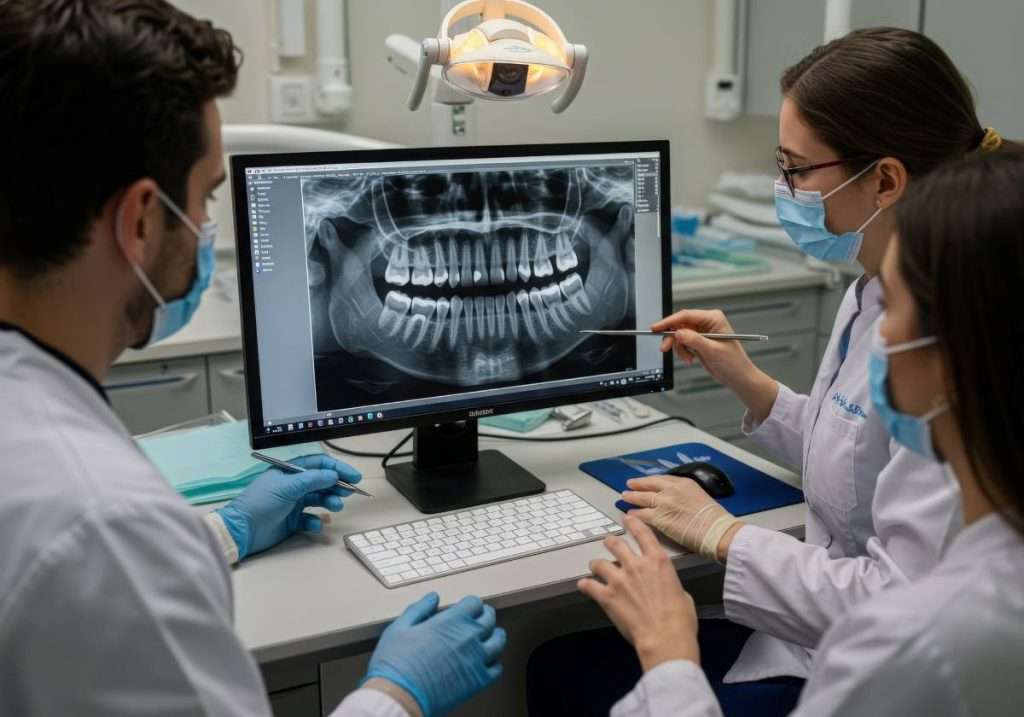
Both can straighten teeth. The difference is volume, equipment and what happens when a case turns out to be more complicated than it looked. For simple alignment either works. For anything involving the bite, the number of similar cases they’ve finished matters more than anything else you can compare.
Your general dentist may well offer aligners. An orthodontic clinic does nothing else all day. Neither of those facts settles it on its own, so here’s what actually separates them.
What you can check before you book either
Every dentist and orthodontist working in the UK is on the General Dental Council register, which anyone can search for free. It shows when they qualified, where, and whether they hold specialist registration in a recognised field.
That’s the objective starting point. It takes half a minute and it’s more useful than any amount of website copy, including this page.
Why volume matters more than the orthodontic clinic’s branding
Someone who finishes two hundred orthodontic cases a year has met your problem before. Someone who finishes eight a year may well do an excellent job, and will have seen fewer of the ways a case goes sideways.
You can just ask. How many cases like mine do you finish in a year? It isn’t a rude question and a confident answer is reassuring in a way that a brochure isn’t.
Where an orthodontic clinic and a general practice genuinely diverge
Simple alignment of the front teeth, healthy bite. Either setting handles this well. A general practice doing it alongside your check ups is convenient and often cheaper.
Bite correction, skeletal problems, children in growth. This is where a practice doing orthodontics all day pulls ahead, because these cases need appliances a general practice rarely stocks and judgement built on having seen a lot of them. Functional appliances, lingual braces and two phase children’s treatment all sit here. Our functional braces and children’s braces pages cover what those involve.
A case that stops behaving. Teeth that won’t move as planned, a root resorbing, an unexpected relapse. The question isn’t whether someone can start your treatment. It’s who finishes it when it stops being straightforward.
The practical differences you’ll notice
Appointment length and frequency. A practice running orthodontics all day has the clinical time blocked out for it. One fitting it between check ups and fillings sometimes doesn’t.
Equipment. Scanners, and in some cases 3D imaging, are standard in an orthodontic clinic and optional elsewhere.
Continuity. Ask who you’ll see at each visit. Over eighteen months this matters more than people anticipate at the start.
What happens with everything else. A general practice does your fillings and your ortho in one place, which is genuinely convenient. Worth noting that we do both too, with general dentistry alongside the orthodontics, so that convenience isn’t automatically a reason to choose one over the other.
The questions that cut through it
Ask all five of these wherever you go.
- How many cases like mine do you complete each year?
- Who will I see at each appointment?
- What would you do if this case didn’t progress as planned?
- Does the quote include retainers?
- What alternatives did you consider for me, and why did you rule them out?
The fifth is the most revealing. A single option with no alternatives mentioned usually means the choice was made by what’s available rather than by what your bite needs.
What this isn’t about
It isn’t about price. A general practice is often cheaper, sometimes materially so, and for a straightforward case that can be perfectly sensible.
It also isn’t about dismissing general dentists. Your dentist is the one who spots the problem, keeps the gums healthy throughout, and handles everything orthodontics doesn’t touch. A good outcome usually involves both, with hygiene running alongside treatment wherever it’s being done.
Where we are
We’re at 2 Grosvenor Gardens on the fourth floor, two minutes from Victoria station. Patients come on foot from Belgravia, Pimlico and Westminster, and from Chelsea, Knightsbridge, Mayfair and Marylebone in minutes. Orthodontic treatment means appointments every six to eight weeks for a year or more, so proximity is worth weighing. We’re open until 8pm on Wednesdays and Thursdays and Saturdays 9am to 5pm.
Common questions
Is a dedicated orthodontic practice more expensive? Often, yes. More of the fee goes on clinical time from someone doing orthodontics exclusively. For a complex case that’s what you’re paying for. For a minor one it may be more than you need.
Can my dentist refer me? Yes, and many do. You can also book an assessment directly without a referral.
What if I’ve already started treatment elsewhere? Transfers mid treatment are common. Expect a transfer fee and new records at the new practice.
How do I know if my case is complex? Get two assessments and compare what each says about your bite rather than your front teeth. If one talks only about appearance and the other talks about how your teeth meet, that difference is the answer.
Does an orthodontic clinic do general dental work too? Some do, some don’t. We do, which means hygiene and check ups happen in the same place as treatment.
Book an assessment
A consultation is £275, deducted from your treatment cost if you go ahead, and you leave with a written plan, a timescale and a price. Book online or call 020 3858 0068.
Boston Orthodontics, 2 Grosvenor Gardens, 4th Floor, Belgravia, London SW1W 0DH. Full pricing on the 2026 fees page.
MOST POPULAR TREATMENTS
Our Services

Our Doctor
Meet Doctors

Dr. Elif Keser
Specialist Orthodontist

Dr. Tania Rafael Garcia
Dental Surgeon

Dr. Gustavo Silva
Dental Surgeon
