
Impacted Canine Teeth in Children: Signs, Causes and Treatment
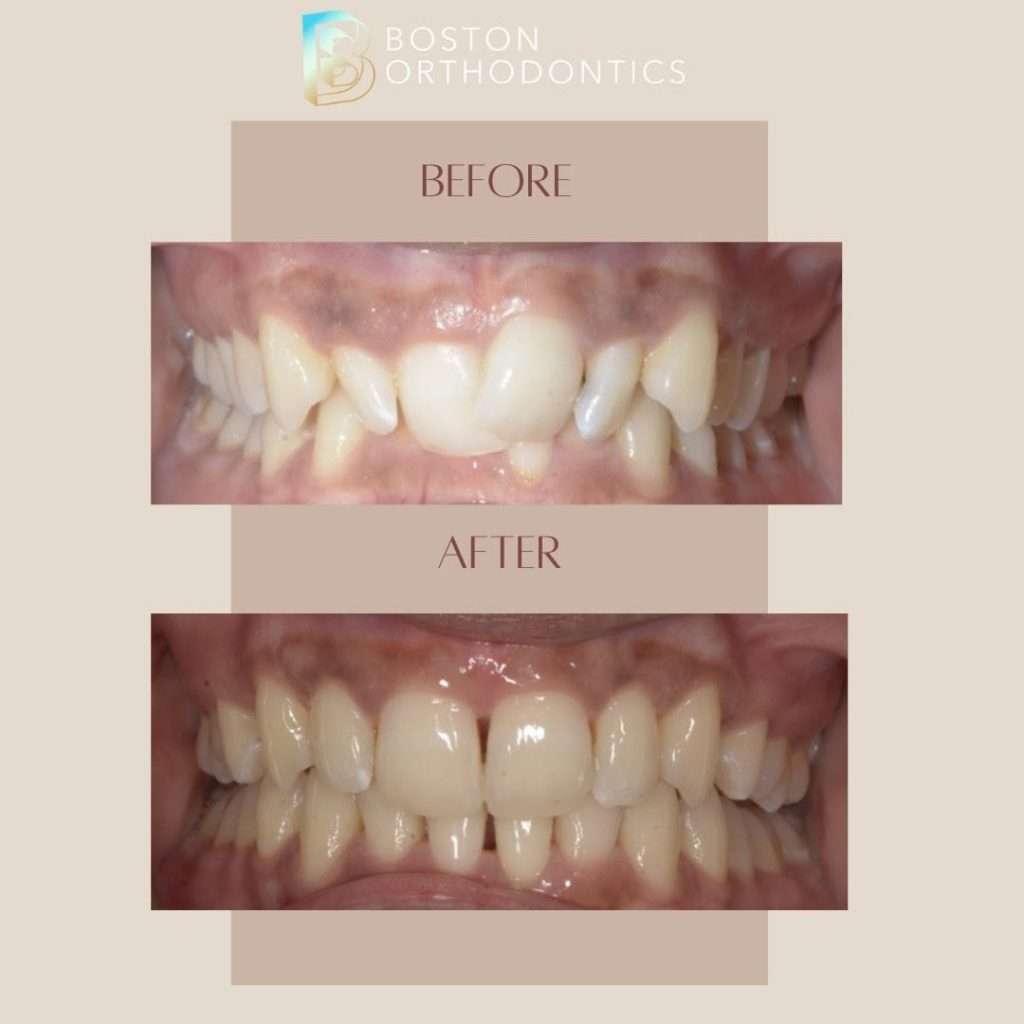
An impacted canine is an adult eye tooth that is stuck in the jaw and has not come through. After wisdom teeth they are the most commonly impacted teeth in the mouth, and the window where treatment is simplest is roughly ages 9 to 11. They are usually painless, which is exactly why they get missed.
If your child’s baby canine is still firmly in place well after the front teeth have changed, that is the signal to have it looked at rather than waited out.
When adult canines should come through
Upper adult canines normally arrive between about 11 and 12. Research published in the British Dental Journal treats eruption as late at around 12 to 13, and recommends that dentists start feeling for the developing canine high in the gum from about age 8 to 10.
Before the tooth appears you can usually feel it as a small firm bump high on the gum above the baby canine. If that bump cannot be felt by about 10 or 11, it is worth an x-ray rather than another year of waiting.
The signs
- A baby canine still firm well after age 12.
- One adult canine through, but not the matching one on the other side.
- A bulge in the roof of the mouth, or high on the gum.
- The front tooth next door tilting or sitting at an odd angle.
- A gap where the canine should be, or crowding closing over it.
The asymmetry one is the most useful for parents. If one side has arrived and the other has not after several months, that is not patience territory.
Why canines get stuck
Canines have the longest roots in the mouth and the longest distance to travel to get into position, so there is simply more that can go wrong on the way. The usual reasons:
- Crowding, where there is not enough room in the arch.
- The tooth developing at the wrong angle, so it is aimed into bone rather than into the gap.
- A baby canine that will not loosen, blocking the path.
- Small or missing teeth next door, which give the canine less to guide itself against.
- Family history, which is a genuine risk factor worth mentioning at the appointment.
Why catching it early matters so much
An impacted canine can press against the roots of the front teeth beside it and damage them. That damage is painless and invisible, which is the entire problem: by the time anything is noticeable, a healthy incisor may already have lost root length permanently.
Caught early, the options are simple and sometimes barely interventional. Caught late, the same tooth needs surgical exposure and a long course of braces, or comes out. This is the clearest case in children’s orthodontics for the value of a check before anything hurts, and the reason we recommend a first orthodontic look at around age 7. Our early orthodontic treatment page covers what that appointment involves.
How impacted canines are treated
Treatment depends on your child’s age, where the canine sits and how much space there is. X-rays, and a 3D scan where needed, show exactly where the tooth is before anything is decided.
| Option | What it involves | When it is used |
|---|---|---|
| Monitoring | Regular checks and x-rays | The canine is late but pointed in a good direction |
| Removing the baby canine | Taking out the baby tooth to clear the path | Caught early, often 10 to 13, with the adult tooth not badly displaced |
| Creating space | An expander or braces to make room in the arch | Crowding is blocking the canine |
| Exposure and alignment | A minor procedure to uncover the tooth, then braces to guide it in | The canine will not come through on its own |
| Removal | Taking the impacted canine out | Occasionally, where the tooth sits in a very poor position |
Where a minor surgical procedure is needed, it is carried out alongside an oral surgeon, and fixed braces then bring the tooth into line gradually over months.
How long it takes
Monitoring or taking out a baby tooth can be the whole of it in early cases. Where a canine needs exposing and guiding into place, treatment runs longer than a standard course of braces, because the tooth has considerably further to travel. You get a timeline at the assessment rather than an estimate afterwards.
Where we are
We are at 2 Grosvenor Gardens on the fourth floor, two minutes from Victoria station, with families coming from Belgravia, Pimlico, Westminster, Chelsea, Knightsbridge and Mayfair. Every orthodontic assessment here is with Dr Elif Keser, our specialist orthodontist, who has worked in orthodontics only since 1998. Children’s appointments are easier out of school hours, so we are open until 8pm on Wednesdays and Thursdays and Saturdays 9am to 5pm.
Common questions
Is an impacted canine an emergency? No, but it should be checked soon. Early treatment is simpler and it protects the neighbouring teeth from root damage.
Can an impacted canine come through on its own? In younger children, often. Removing the baby canine or creating space can be enough to let the adult tooth find its own way in.
Does exposing a canine hurt? It is done under anaesthetic, so your child should not feel pain during it. Mild soreness for a few days afterwards is normal.
Can adults have impacted canines treated? Yes, though it is more complex once growth has finished. An assessment will show what is realistic.
What age should my child first see an orthodontist? Around age 7. That is early enough to catch a canine developing off course, which is the main thing being looked for at that visit.
Book a children’s orthodontic check
A consultation is £275, deducted from treatment cost if you go ahead, and you leave with a written plan and a clear answer on whether this needs treating now or watching. Book online or call 020 3858 0068.
Boston Orthodontics, 2 Grosvenor Gardens, 4th Floor, Belgravia, London SW1W 0DH.
MOST POPULAR TREATMENTS
Our Services

Our Doctor
Meet Doctors

Dr. Elif Keser
Specialist Orthodontist

Dr. Tania Rafael Garcia
Dental Surgeon

Dr. Gustavo Silva
Dental Surgeon
